Your kidneys may not be the first thing you think about when you exercise. You usually think about your heart, muscles, weight, or fitness. But your kidneys benefit from the same healthy habits. Best Exercises for Kidney Health can support an active lifestyle while helping you manage important factors such as blood pressure, blood sugar, body weight, and cardiovascular health—all of which are closely connected to kidney health. For people living with kidney disease, staying active can also support physical function, energy levels, and overall quality of life.
The important point is that you do not need an intense workout to support your kidneys. Walking, cycling, swimming, strength exercises, and simple daily movement can all have a place in a kidney-friendly lifestyle. The right choice depends on your age, fitness, kidney function, other health conditions, and how your body responds to exercise.You do not have to exercise harder to take better care of your kidneys. You have to move consistently, safely, and in a way your body can sustain.
How Does Exercise Help Your Kidneys?
Exercise does not directly “clean” the kidneys or repair permanently damaged kidney tissue. Its benefit is more indirect—but extremely important. Your kidneys work within a larger system. When blood pressure, blood sugar, circulation, body weight, and cardiovascular health are better controlled, the kidneys are exposed to fewer of the factors that can contribute to ongoing damage.
Regular activity can help by:
What Are the Best Exercises for Kidney Health?
There is no single “best” kidney exercise. In most people, the most useful approach combines aerobic activity, muscle-strengthening exercises, and flexibility or balance work.
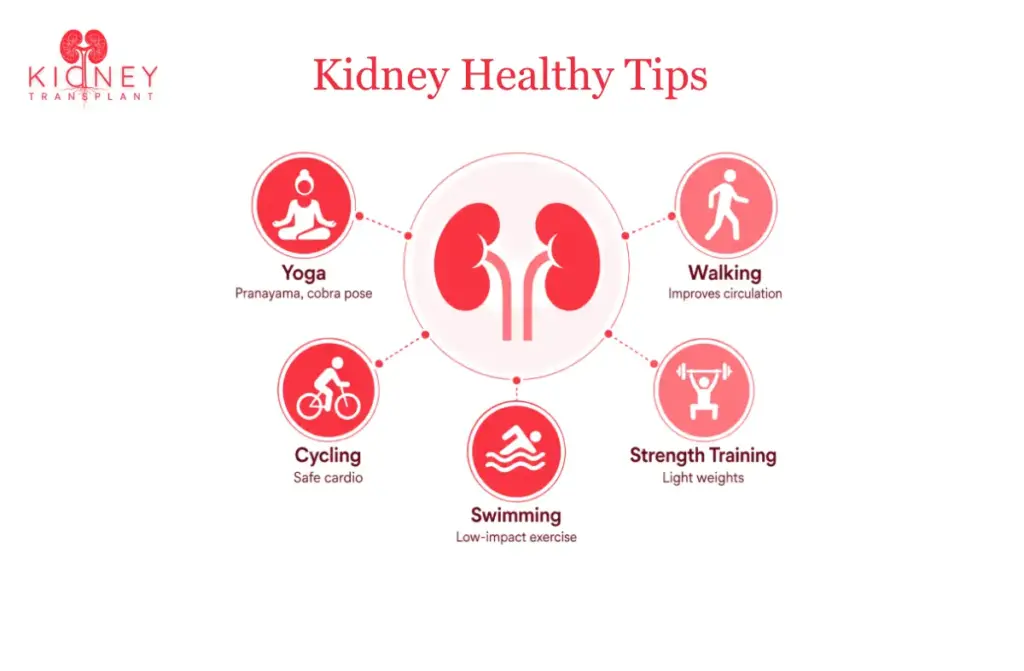
Walking, Cycling and Swimming: Simple Choices That Work
You do not need complicated equipment or a specialised programme to begin.
- Walking is often the easiest starting point because it is accessible, low-impact, and can be adjusted to your fitness level. A brisk walk can raise your heart rate without placing excessive stress on the joints.
- Cycling provides cardiovascular exercise while reducing the impact on the knees and hips. A stationary bicycle can be particularly convenient if outdoor cycling is difficult.
- Swimming or water-based exercise can provide a full-body cardiovascular workout while placing less stress on weight-bearing joints.
The best option is usually the activity you can perform regularly without excessive fatigue, pain, or breathlessness.
Strength Training: An Important Part of Kidney-Friendly Exercise
Cardio often gets most of the attention, but maintaining muscle strength becomes increasingly important as we age.
Strength exercises can include body-weight movements, resistance bands, light weights, or appropriately adjusted gym exercises. They help maintain muscle mass, strength, balance, and the ability to perform everyday activities.
For someone with kidney disease, strength training should not automatically mean lifting very heavy weights.
A safer approach is to begin with manageable resistance and focus on controlled movement and proper technique. Your doctor or physiotherapist may recommend specific adjustments depending on your kidney function and other medical conditions.
Simple Strength Exercises
- Sit-to-stand exercises: Repeatedly standing up from a sturdy chair can strengthen the thighs and improve functional strength.
- Wall push-ups: These provide a gentler way to work the upper body than traditional floor push-ups.
- Resistance-band exercises: Bands allow you to strengthen different muscle groups while controlling the amount of resistance.
- Light weight exercises: Small weights can be useful when performed with proper technique and appropriate intensity.
The goal is to keep your muscles strong enough to support your everyday life.
Stretching, Flexibility and Balance Matter Too
Not every beneficial movement needs to leave you sweating. Stretching and balance exercises can help maintain flexibility, mobility, coordination, and confidence with movement. This becomes particularly valuable for older adults and people whose kidney disease or other health conditions have reduced their physical activity.
Gentle stretching, mobility exercises, yoga, and balance exercises can complement aerobic and strength training. For people with reduced stamina, even short sessions can be useful. Movement does not have to look like a workout to benefit your health.
How Much Exercise Should You Do?
The right amount depends on your health and fitness level, but the general goal for healthy adults is to gradually work toward regular moderate-intensity physical activity throughout the week, combined with muscle-strengthening activity.
You do not need to reach that level immediately.
If you have been inactive for a long time, starting with a 10–15 minute walk may be more realistic than suddenly attempting a one-hour workout.
You can gradually increase the duration as your body adapts.
A Simple Progression
| Starting Point | What You Could Try |
| Very inactive | Short, easy walks for 5–10 minutes |
| Beginning to build fitness | 15–30 minutes of walking, cycling or swimming |
| Comfortable with regular activity | Gradually increase duration or intensity |
| Already active | Combine aerobic exercise with strength and flexibility work |
The most important principle is consistency rather than intensity. A manageable routine that you follow week after week is generally more valuable than an exhausting workout that leaves you unable to exercise for several days.
Exercise for Men and Women: Is There a Difference?
Men and women do not need completely different exercises to protect kidney health. The basic benefits of aerobic activity, strength training, flexibility, and regular movement apply to both.
| For Men | For Women |
| Regular aerobic exercise can support cardiovascular fitness, blood pressure, and metabolic health. | Regular aerobic exercise can support cardiovascular fitness, blood pressure, and metabolic health. |
| Strength training can help preserve muscle mass and physical function, particularly with ageing. | Strength training can help preserve muscle, strength, and bone health, particularly as women age. |
| Men with kidney disease should consider cardiovascular health and blood pressure when increasing exercise intensity. | Women with kidney disease should consider cardiovascular health, bone health, life stage, and overall kidney function when planning exercise. |
| Exercise intensity should be increased gradually rather than suddenly. | Exercise intensity should also be increased gradually, with adjustments for pregnancy, postpartum recovery, menopause, or other health conditions when relevant. |
What changes is the individual’s health, age, fitness level, and medical situation.
The important difference is not “male exercise versus female exercise.” It is personalised exercise. Your kidney function, age, fitness level, medications, blood pressure, cardiovascular health, and other medical conditions matter far more than gender alone.
What If You Already Have Chronic Kidney Disease?
If you’re living with chronic kidney disease, you might wonder whether exercise is even something you should be doing. The answer, for most people, is yes, it can still be genuinely beneficial. Staying active may help you hold onto strength, keep your heart in better shape, maintain your independence, and simply feel more like yourself day to day.
That said, exercise for chronic kidney disease isn’t one-size-fits-all. What works well for you will depend a lot on where you are in your kidney disease journey and how your overall health looks right now.
If you’re in the early stages of chronic kidney disease and feeling relatively well, you may be able to follow a fairly normal exercise routine, not too different from what anyone else might do.
But if your kidney disease is more advanced, or you’re dealing with things like significant anaemia, heart disease, or ongoing fatigue, your body may need a gentler, more carefully supervised approach.
When Should You Be Careful While Exercising?
Exercise should generally leave you feeling worked but not seriously unwell.
Stop exercising and seek medical advice if you experience concerning symptoms such as:
- Chest pain, pressure, or unusual discomfort: These symptoms should not be pushed through during exercise.
- Severe or unexpected shortness of breath: Breathlessness that feels disproportionate to the activity requires attention.
- Dizziness, fainting, or marked weakness: These may indicate that your body is not tolerating the activity appropriately.
- A sudden or significant change in your usual symptoms: Particularly if you already have kidney or heart disease.
- Severe muscle pain, swelling, or unusual physical symptoms: These should be assessed rather than ignored.
If you have significant kidney disease or another major medical condition, speak with your healthcare professional before beginning a new high-intensity exercise programme.
What About Exercise During Dialysis?
People receiving dialysis should not assume that exercise is completely off-limits. Physical activity may still be possible and can help maintain strength and physical function, but the timing and type of exercise matter.Some dialysis centres incorporate exercise or rehabilitation programmes into care.
Depending on the individual, gentle activity may be performed on non-dialysis days or under professional supervision during treatment. If you are on dialysis, do not simply copy an intense workout programme from someone who does not have kidney disease. Your dialysis team can help determine what is appropriate for you.
A Simple Kidney-Friendly Exercise Routine
If your doctor has not given you exercise restrictions, you can think of your routine in three simple parts:
Move your heart. Build your muscles. Keep your body mobile.
For example:
| Day | Simple Activity |
| Monday | 20–30 minute walk |
| Tuesday | Light strength exercises |
| Wednesday | Walking or cycling |
| Thursday | Gentle stretching and mobility |
| Friday | Walking or swimming |
| Saturday | Light strength exercises + short walk |
| Sunday | Rest or gentle movement |
Conclusion
Exercise is not a cure for kidney disease, and it cannot reverse permanently damaged kidney tissue. Its value lies somewhere else. By supporting blood pressure, blood sugar, cardiovascular health, body weight, muscle strength, and physical function, regular movement can help create a healthier environment for your kidneys and your whole body.You do not need an expensive gym membership. You do not need an extreme workout. And you do not need to become an athlete.
A regular walk, a few strength exercises, a swim, a cycle ride, or simply becoming more active throughout the day can be a meaningful beginning.The best exercise for kidney health is not necessarily the hardest one. It is the one that is safe for you, fits your life, and is sustainable enough to become a habit. If you already have kidney disease, especially advanced CKD or dialysis-dependent kidney failure, your exercise plan should be individualised with your healthcare team rather than copied from a general fitness programme.
Read More: High Blood Pressure and Kidney Damage